
Graham Previous Resident Sources
No single roll names everyone who occupied a Graham address. Start with the period being studied, then match the record to the question. Deeds document transfers. Directories and census schedules can place households. Permits document work at a site. Probate and obituaries can explain why a name leaves the trail.
| Source | Years It Covers | Where Held | What It Shows |
|---|---|---|---|
| Pierce ARMS recorded documents | Generally 1984-present online | Pierce County Auditor | Deed parties, dates, numbers, instrument types, and some images |
| Historical deed indexes | Pre-1984; State Archives index 1888-1977 | Auditor and Puget Sound Regional Branch | Older grantor, grantee, and legal-description trail |
| Pierce and Tacoma directories | Scattered runs from 1882 onward | State Library, regional libraries, and FamilySearch | Name, address, work, and household clues |
| Federal census | Public releases through the 72-year rule | National Archives and library databases | Household members and address geography on the census date |
| PALS permits and cases | Current portal; start year not documented | Pierce County Planning and Public Works | Applications, inspections, site work, and code-case dates |
| Probate and newspapers | Collection-dependent | Clerk, LINX, State Archives, libraries | Estates, heirs, notices, moves, and family links |
For a modern transfer, begin online. For an early Graham parcel, expect an office, archive, microfilm, or request step. For occupants rather than owners, start with the deed only to establish the parcel and dates, then turn to household sources.
Anchor Graham Resident History
The safest backward trail begins in the Pierce County Assessor-Treasurer portal or PublicGIS. Save the parcel number, exact situs address, legal description, subdivision, lot and block, and current owner or taxpayer label. A situs address is the physical site. The mailing address is where tax notices go, and it does not prove where an owner lives.
Keep all unit and tract details when one street number covers several structures, manufactured-home spaces, or related accounts. The parcel and legal description survive many spelling and formatting changes. They also help separate adjacent properties that share a road name. Graham's county status makes this vital because a postal place, Census boundary, service district, and old directory label may not agree.
Note: A taxpayer name links a person or entity to an assessment role, not to every previous resident of the site.
Trace Graham Previous Residents
The Pierce County ARMS index is based on parties, recording metadata, and legal descriptions. It is not a dependable street-address search. That quirk changes the work: identify today's parcel first, then use each seller to find the transfer by which that person or entity acquired it.
- Copy the current owner label, parcel number, and legal description from ATIP or PublicGIS.
- Search the current owner as grantee and locate the purchase deed or relevant transfer in ARMS.
- Record the recording number, date, instrument type, grantor, grantee, legal description, and image status.
- Search the seller as an earlier grantee. Test spouse names, trustees, estates, entities, and name variants.
- At the online boundary, move to Auditor books, microfilm, office copies, State Archives indexes, or a formal request.
- Grantor and grantee
- The grantor gives an interest; the grantee receives it.
- Chain of title
- The dated sequence of recorded transfers affecting the same property.
- Legal description
- The lot, block, subdivision, survey, or metes-and-bounds wording that identifies land more reliably than an old street number.
The ARMS search screen shows the official recorded-document route.
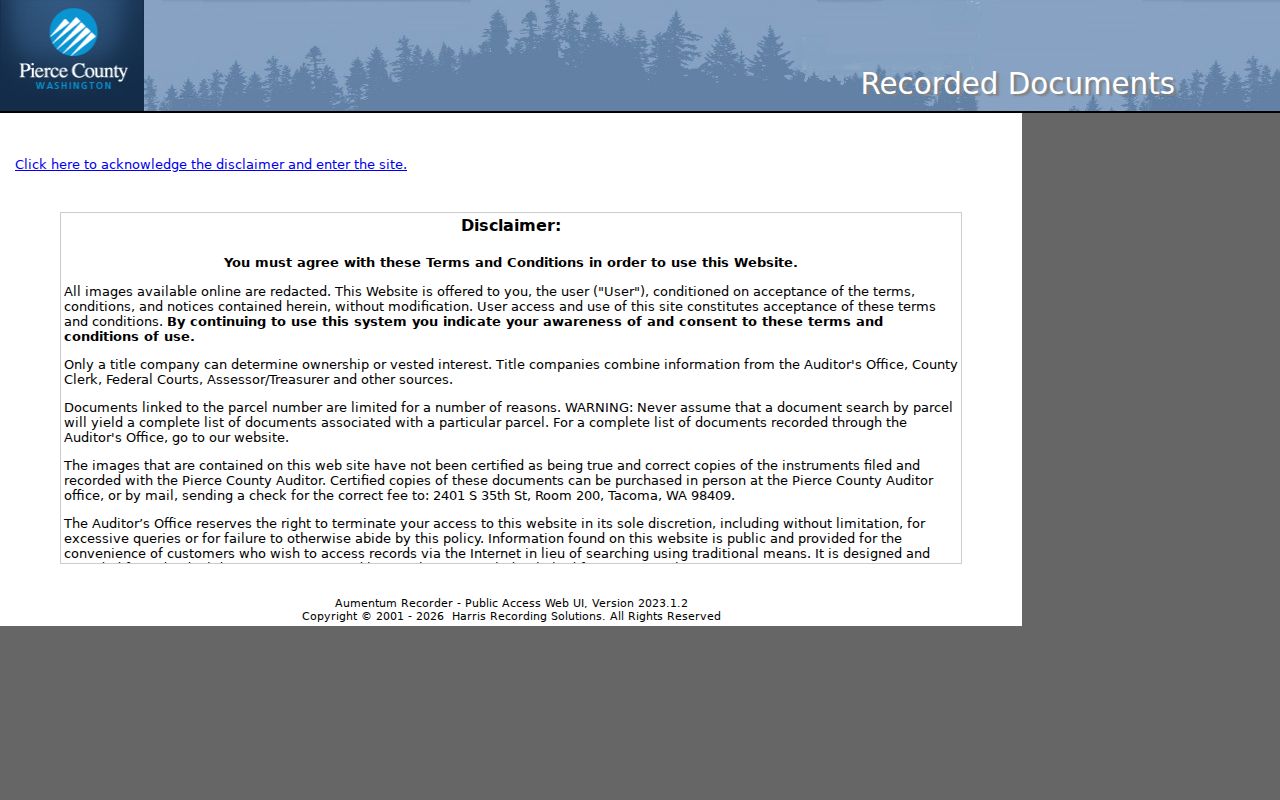
The capture reinforces the party-based search method. Preserve the legal description as each grantor and grantee changes.
Earlier Graham Resident Records
Pierce County's online recorded-document material generally begins around 1984. That is an access boundary, not the start of Graham land history. The Auditor can supply older index books and deed material, while the State Archives has a general recordings index from 1888 through 1977. The two date ranges need not align neatly because holdings and instrument coverage vary.
Archive staff cannot retrieve property records from a street address alone. Send the parcel number, legal description, subdivision or lot and block, estimated date, instrument type, grantor, grantee, and county. The Puget Sound Regional Branch can help identify the right Pierce series. Its phone is 425-564-3940 and its email is psbrancharchives@sos.wa.gov.
The official regional branch page shows the offline access point.
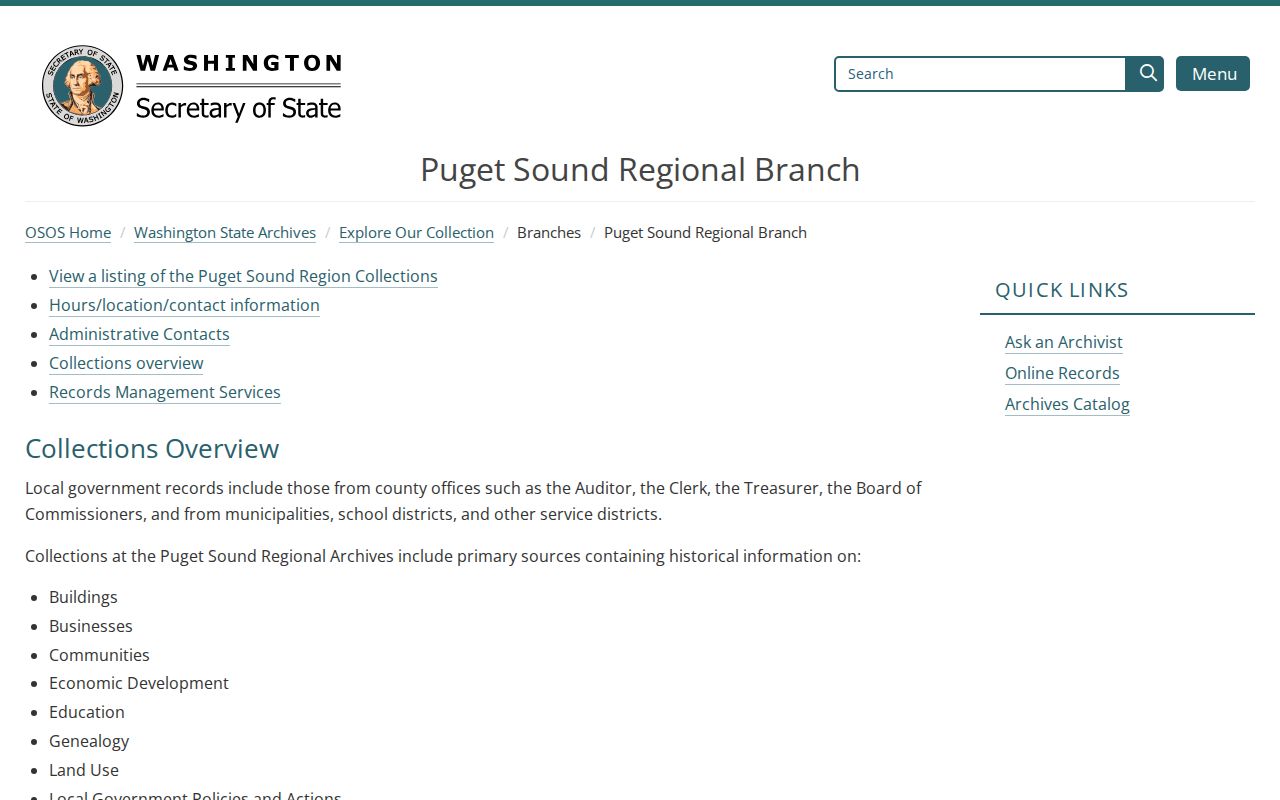
The archive route carries a previous-resident search past the web index, provided the request includes stable land identifiers.
Graham Previous Resident Addresses
Old Graham addresses can appear under a rural route, subdivision, nearby town, Tacoma suburb, or a different postal label. E911 changes and street-number shifts can also break an exact search. No official source located a specific Graham-wide renumbering project or date, so a changed number must be proved from the parcel, plat, map, or deed rather than assumed.
Build an address-variant list. Include directional prefixes, street suffixes, route notation, unit numbers, subdivision, lot and block, and nearby place names. Then compare map geometry and legal descriptions. This method is stronger than forcing today's address into every old index. It also prevents a Tacoma-area directory entry from being claimed as Graham without boundary or parcel evidence.
Note: Keep the historic label in citations even after linking it to the modern Graham parcel.
Find Graham's Past Households
Ownership is only half the answer. Pierce County, Tacoma, and suburban directories provide scattered name-and-address snapshots from 1882 onward. Census schedules add household members, occupation, birthplace, and address geography on the census date. The collection years and repository details are covered more fully in the Graham city directory material.
Use a short process flow: deed date to nearest directory year, then directory name and address to the closest public census, then census household to newspaper, obituary, or probate. Repeat on both sides of a transfer. A person recorded as grantee, a person listed at the address, and a person named in an estate may be the same, but each statement needs its own source and date.
- Choose the directory year nearest the deed or assessment date.
- Search the surname and address variants, then inspect any street-order section.
- Compare the closest released census schedule and note every household member.
- Use an obituary, newspaper notice, or probate file to explain a move, death, or estate transfer.
Lawful use. Research Graham house and family history with care. Never use an address trail to track, harass, or harm a living person.
Graham Resident History Help
House-history support is regional. Pierce County Library offers genealogy databases, microfilm, obituary help, and research assistance. The Tacoma Historical Society holds nearly a century of directories, more than 400 bound newspaper volumes dating to 1883, and school yearbooks. The Pierce County Historical Documents Survey catalogs maps, plats, photographs, newspapers, oral histories, and architectural drawings for unincorporated communities.
The Tacoma Public Library Northwest Room buildings index can add an architect, contractor, directory years, clippings, or property-history leads. It is a lead set, not proof that every indexed building lies in Graham. No dedicated, guaranteed Graham house-history service was found. Give a librarian or archivist the same parcel worksheet used for the deed search so staff can route the request accurately.
The Pierce County Historical Documents Survey is especially useful for Graham because it focuses on unincorporated communities and places without their own preservation programs. Search its catalog by repository, collection, keyword, map or plat, photograph, newspaper, diary, oral history, or architectural drawing. A catalog result identifies a promising item and its keeper; it does not prove who occupied the parcel. Add the repository name and catalog description to the worksheet, then request the underlying record before using its details.
Map Graham Previous Residents Carefully
Sanborn fire-insurance maps can date building shape, use, and nearby features, but no Graham-specific Sanborn edition was found through the official State Library or Library of Congress routes. Nearby Tacoma, Puyallup, or Orting sheets should be used only when the historical address falls within their mapped coverage. Rural Graham may be better served by plats, surveys, aerial context, assessment rolls, and county maps.
The Pierce County PALS portal adds permits, inspections, applications, documents, and code-case dates. Its portal start year was not documented, so do not assign a coverage date. A permit applicant or named owner is a site connection, not a full occupant list. Compare it with the deed and household trail.
Close Graham Previous Resident Trails
A previous resident may leave the directory because of a move, death, publication gap, missed canvass, or new address label. Tacoma Times issues from 1903 through 1949 and local Graham-area papers can supply obituaries, marriage reports, legal notices, school events, and property notices. Search with the address, spouse, occupation, subdivision, and date range rather than a name alone.
Probate can connect an estate, heirs, representatives, and later addresses. LINX provides post-2002 Superior Court information, while older files may require a Clerk request or State Archives series. Keep the conclusion narrow: the deed proves a recorded transfer, the directory or census supports occupancy at a date, and the obituary or probate file supports a family or estate link. That sourced chain answers who lived here before without turning a clue into a claim.
State Archives offers more than the recordings index. Pierce County holdings include selected assessment rolls, school census material from the 1870s through the 1890s, marriage series, probate journals, wills, and territorial census records. An assessment can place an owner or taxpayer in a given year, while a school census may reveal a family in an area between federal census dates. Collection dates vary, and many records require staff help. Cite the series, box or volume, page, and date whenever available so the link to the Graham parcel can be checked later.
Maintain three separate findings in the final notes: recorded owner, listed occupant, and estate or family connection. If all three point to the same person, the agreement is meaningful. If they conflict, keep the conflict visible and search the surrounding years. Trusts, companies, lenders, and estate representatives often appear in land records without living at the site. A strong previous-resident history reports those roles accurately instead of forcing every recorded name into a household.